
Studie
Die Zukunft von Unternehmen im Zeitalter der KI
The Future of Enterprises in the Face of AI
A peek into the study
Scenario 1) The Rise of Humans
People thought, that automating tasks with AI would bring productivity increases similar to when tractors replaced horses. But AI went further than everyone could dream. It created an unprecedented surge in productivity. Initially, enterprises focused on AI-powered cost leadership. Whoever offered the lowest prices, won. But it has gotten increasingly difficult to compete on price, because technological advances made any cost advantage temporary and short-lived. And now, finally, marginal costs are effectively zero for all physical and digital goods. AI is controlling every single machine along the entire supply chain. It’s writing every single line of code. Humans were made unnecessary in the process of creating physical or digital goods.
But contrary to what the prophets of doom predicted, it completely changed what customers found valuable. This development made human time the most valuable resource in business. In 2023, branding was a major value driver. In 2033, AI makes all physical and digital brand differentiators available to all enterprises. But this didn’t mark the death of branding. The opposite! With physical and digital goods being ubiquitously available, the singular differentiating factor of businesses is brand perception. And brand perception is now created by human interaction.
But today, people have no existential reason to work anymore. The only question that applicants demand an answer to in hiring interviews is: Why? Why should I invest my time here? And time is scarce. After the four-day week became common, working times further decreased. It is now common to measure the weekly working time in hours. And that brought an unprecedented labour shortage. The single point of focus for executives nowadays is to attract and convince individuals that can adequately represent the brands of the enterprise.

About the study:
Artificial Intelligence is fundamentally changing business
Leaders must act swiftly and deliberately… or do they?
In November 2022, the technology market has made a quantum leap when ChatGPT was released to the public. Since then, the business world has been turned upside down. Hundreds of start-ups in the space of applied AI have sprung up, promising to replace virtually every corporate job that somehow involves a human using a computer – and they come equipped with almost unlimited capital as VCs are itching to pour their funds into the space.
Legions of small businesses globally have, virtually over night, integrated AI into their processes ranging from product development to supply chain management and customer service.
Shifts that may turn out to be tectonic are happening amongst the large tech players: Microsoft incorporated ChatGPT in its search engine Bing – a move that is widely perceived as an attempt to dethrone Google as the leading global search engine.
In short: Things are moving at an unprecedented, exponential pace. Whoever picks up AI first, and most effectively, will set the pace in their market.
But let’s take a step back for just a second. We have seen this before in recent history, didn’t we? After dotcom and Virtual Reality, are we witnessing the third big hype cycle of the early 21st century? It seems unlikely that AI is just a fad because the use cases are too specific and there has been proof-of-value for too many applications. But what if AI turns out to be disproportionately useful, but ultimately remains a supporting technology?
The impact of AI is largely misunderstood by the public
One thing is abundantly clear: Many of the changes that AI brings are counterintuitive. And accordingly, the public expectation is often completely off.
One fundamental example is the tremendous misjudgement in the general population about the type of work that is about to be replaced by AI. ”Simple” jobs are perceived to have the highest likelihood of automation.
It’s an obvious conclusion because for decades, manual labour has increasingly been replaced by machines. But AI works fundamentally different than most people perceive it to. AI is not a robot in the physical sense. Robots were modeled to carry out physical tasks. AI is a computational engine built to process information and carry out cognitive tasks. Its models are based on the human brain. Except, that AI has two almost unfair advantages over humans: Its computational power can be scaled up, and its thinking processes (”algorithms”) and the very structure of its brain (”proessors”) can be improved.
And on top of that, manual labour today is relatively cheap when compared to specialized knowledge workers. From an economical point of view, white-collar jobs provide the far biggest incentive for automation because they receive a much higher compensation.
The future is all but uncertain. But it may be different than everyone expects
As in the stock market, it’s impossible to predict the immediate future in business. But as in value investing, it’s entirely possible to project the trajectories a market may take.
The key to understanding what drives change and disruption on a macro scale, is to get clarity on why certain outcomes are seemingly hard to predict. In most cases this happens, when statistical models fail because there is no data or insufficient data as a base for a valid prediction. That’s why scenario analysis focuses on identifying uncertainty drivers and then clustering these factors in order to create a base for valid logical conclusions rather that statistical analysis. By clustering the inputs, the outputs are then falling into broad categories, too. This yields valid assumptions that are translated into actionable strategies.
How we Forecast
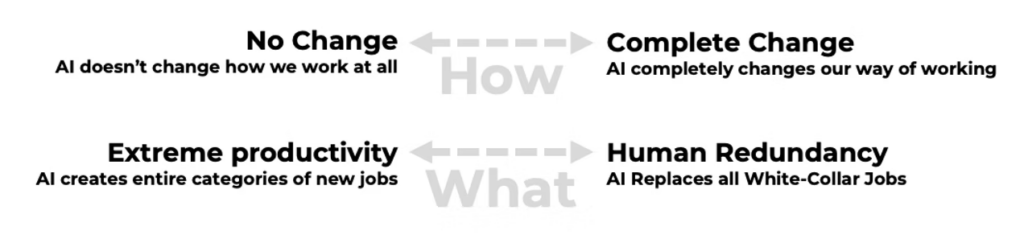
AI will impact HOW people work and WHAT people work
In this study we evaluate what makes today’s future uncertain for businesses and which factors act as uncertainty driver that blur the vision.
We identify two key uncertainty drivers that substantially shape how leaders must prepare for the future. We put each of these two on a spectrum of how, from today’s perspective, they are expected to play out on an extreme level.
The future is all but uncertain. But it may be different than everyone expects
As in the stock market, it’s impossible to predict the immediate future in business. But as in value investing, it’s entirely possible to project the trajectories a market may take.
The key to understanding what drives change and disruption on a macro scale, is to get clarity on why certain outcomes are seemingly hard to predict. In most cases this happens, when statistical models fail because there is no data or insufficient data as a base for a valid prediction. That’s why scenario analysis focuses on identifying uncertainty drivers and then clustering these factors in order to create a base for valid logical conclusions rather that statistical analysis. By clustering the inputs, the outputs are then falling into broad categories, too. This yields valid assumptions that are translated into actionable strategies.
AI will impact HOW people work and WHAT people work
In this study we evaluate what makes today’s future uncertain for businesses and which factors act as uncertainty driver that blur the vision.
We identify two key uncertainty drivers that substantially shape how leaders must prepare for the future. We put each of these two on a spectrum of how, from today’s perspective, they are expected to play out on an extreme level.
In the second step, we examine the future’s intricacies and consider their implications in a series of logical conclusions. And then we assume the perspective of an observer in 2034 that recapitulates 2024’s expectations and how history played out.
In the final step, we derive what would have been the best paths to attain an organization’s desired state in each future scenario. With a defined vision of what different futures may look like, we examine which courses of action will have proven successful for the transition to reach each future state, and which strategic pillars are expected to work in 2034 and beyond.
Results
The four scenarios for 2034 – will people work with AI, or despite AI?
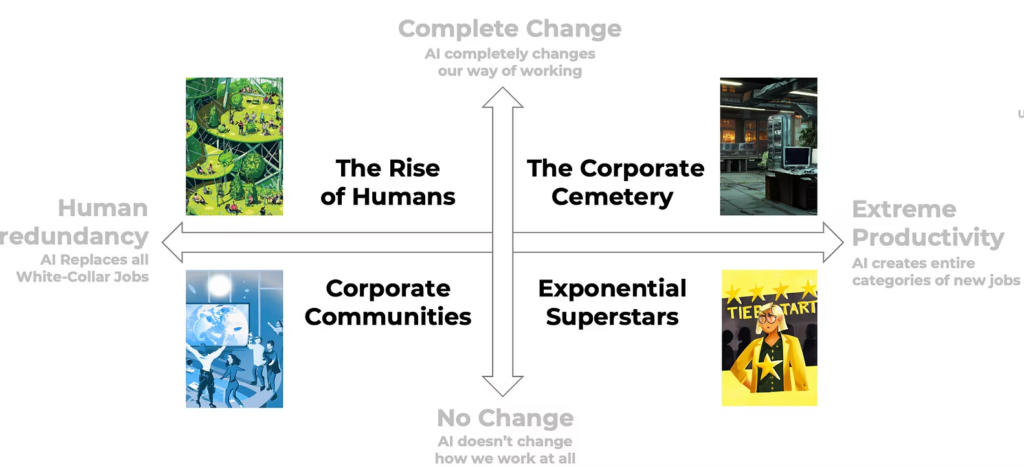
We identify four distinct scenarios and answer critical questions
How can leaders prepare? Where can they safely place their bets? And which strategic pillars that have worked well in the past will require reconsideration and adaption?
The results of our scenario analysis are a detailed description of what the world will look like in 2034. But we don’t stop there. Based on these scenarios, we analyze, which business strategies will fail by 2034, and which will work in 2034 and beyond.
Explore the four scenarios and their implications on Business Strategy and Organizational Design.
Jetzt die gesamte Studie kostenfrei herunterladen
Kein Spam, jederzeit abbestellbar. Mehr dazu in unserer Datenschutzerklärung.